
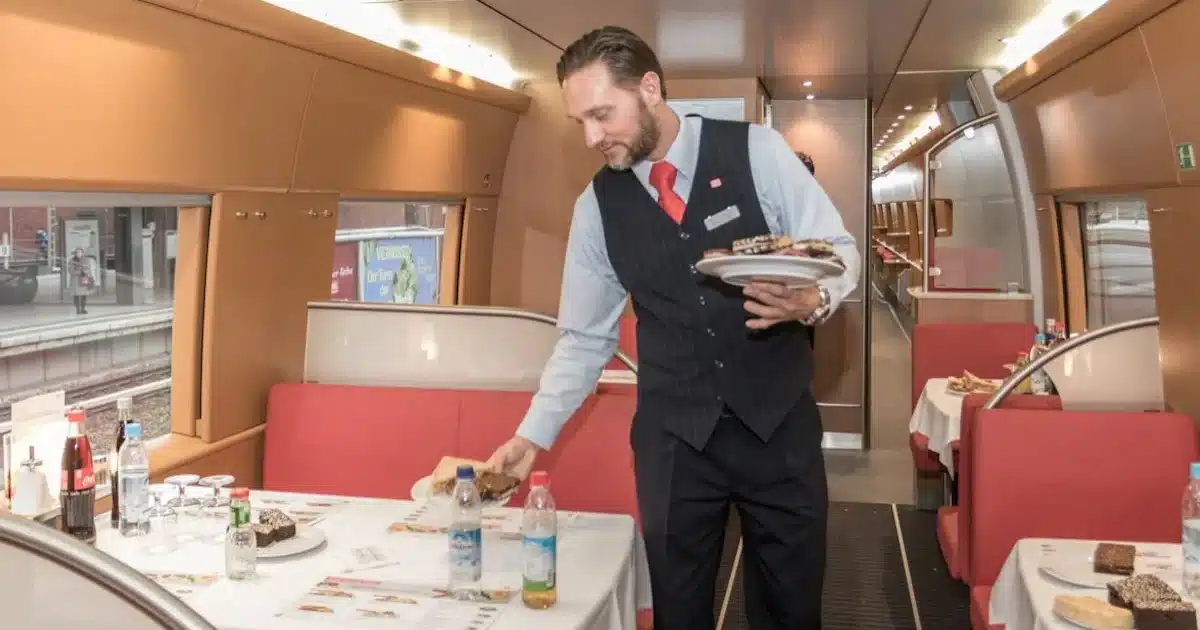
A LNER train employee, Peter Duffy, retrieved sausage rolls from a kitchen bin on 7 May 2023, had them reheated, and served to two first-class passengers aboard a train departing from York. Found guilty of gross misconduct, he was dismissed in July 2023. His two subsequent claims — unfair dismissal and discrimination — were both rejected by a Newcastle tribunal in August 2025.
What was supposed to be a premium travel experience turned into something considerably less appetizing. On a London North Eastern Railway service, two passengers sitting in first class received and ate pastries that had already been thrown away. They had no idea.
The story only came to light because a colleague noticed something was off — and the train's own CCTV cameras captured the rest.
A sausage roll's unlikely journey from bin to first-class table
The sequence of events began in the train's kitchen. A fellow cook announced that the sausage rolls had been discarded, ending up in the bin. Peter Duffy, rather than leaving them there, retrieved the pastries, had them reheated, and passed them along to a colleague. That colleague then served the food to two first-class passengers, who consumed it without any knowledge of its prior destination.
Food hygiene standards exist precisely to prevent this kind of situation. Once food is discarded, it is considered contaminated — exposed to bacteria, cross-contamination risks, and general kitchen waste. Reheating does not neutralize all potential hazards, and serving such food to paying passengers represents a clear violation of basic catering safety protocols.
Consuming food that has been discarded and retrieved from a bin carries real health risks, even after reheating. Food safety regulations in the UK strictly prohibit the service of food that has been treated as waste.
How the incident was discovered
A standard class host working on the same train noticed something unusual — laughter coming from the kitchen area, and the conspicuous absence of the sausage rolls that had supposedly been thrown out. The employee reported what they had witnessed. LNER then reviewed surveillance footage from the train's cameras, which confirmed the account. The visual evidence proved decisive in the investigation that followed.
The ten days between the incident and the inquiry
The events took place on 7 May 2023. Ten days later, on 17 May 2023, LNER convened a formal inquiry meeting. Duffy and his colleague were suspended immediately after the incident came to light. The internal investigation concluded that Duffy had committed gross misconduct, a finding serious enough to justify termination of employment. He was dismissed in July 2023.
LNER's response and the tribunal's ruling
London North Eastern Railway did not treat this as a minor procedural lapse. The company's position was unambiguous: retrieving discarded food and serving it to passengers — particularly paying first-class passengers who expect a certain standard of service — constituted a fundamental breach of food safety obligations and professional conduct.
Duffy contested that decision. He filed two separate claims before the Newcastle tribunal: one for unfair dismissal, one for discrimination. Both were rejected in August 2025. The tribunal's ruling effectively validated LNER's handling of the case, confirming that the dismissal was justified given the nature of the misconduct.
The Newcastle tribunal rejected both of Peter Duffy’s claims in August 2025, confirming that his dismissal for gross misconduct was legally sound.
The case raises broader questions about food handling standards in train catering environments, where kitchens are compact, oversight can be limited, and the temptation to avoid waste may occasionally conflict with safety rules. Whether this was motivated by a misguided effort to reduce food waste or simple poor judgment, the outcome for the passengers involved was the same: they unknowingly ate food from a bin.
What this case says about food safety on trains
Train catering operates under the same food hygiene regulations as any commercial kitchen in the UK. Staff are expected to follow strict protocols around preparation, storage, and disposal. The fact that a standard class host felt compelled to report the incident — and that laughter was audible in the kitchen — suggests the act was not treated with the seriousness it warranted at the time.
Food that has been discarded cannot re-enter service, regardless of its apparent condition. This is not a technicality. It reflects the impossibility of knowing what contaminants a discarded item has been exposed to once it enters a waste bin. The risk to passengers, while perhaps not immediately visible, is genuine.
For anyone who takes food safety seriously — whether cooking at home or working in a professional kitchen — the principle is the same. The standards that govern safe kitchen practices exist to protect people, not to create unnecessary waste. And while food waste is a real concern worth addressing thoughtfully, the solution is never to serve discarded food to unsuspecting diners.
first-class passengers unknowingly served food retrieved from a kitchen bin
The two passengers at the center of this story — seated in first class, presumably expecting a decent hot pastry and a comfortable journey — received something quite different. They were never identified in the proceedings. Whether they ever learned what they had eaten remains unknown. But the tribunal's decision in August 2025 closed the legal chapter on an incident that began with a sausage roll in a bin, somewhere between York and wherever the train was headed.